Wednesday, April 7, 2010

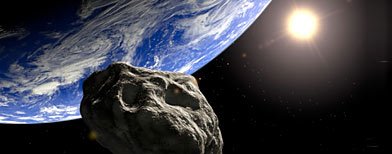
Newfound Asteroid Will Fly Close by Earth Thursday


A newly discovered asteroid will zip close by Earth Thursday, but poses no threat of crashing into our planet even though it is passing within the orbit of the moon.
The asteroid, called 2010 GA6, is a relatively small space rock about 71 feet (22 meters) wide and was discovered by astronomers with the Catalina Sky Survey in Tucson, Az. The space rock will fly within the orbit of the moon when it passes Earth Thursday at 7:06 p.m. EDT (2306 GMT), but NASA astronomers said not to worry...the planet is safe.
"Fly bys of near-Earth objects within the moon's orbit occur every few weeks," said Don Yeomans of NASA's Near-Earth Object Office at the Jet Propulsion Laboratory in Pasadena, Calif., in a statement.
At the time of its closest pass, asteroid 2010 GA6 will be about 223,000 miles (359,000 km) from the Earth. That's about nine-tenths the distance between Earth and the moon [more asteroid photos].
The space rock is not the first asteroid to swing close by Earth this year.
In January, the small asteroid 2010 AL30 passed within 80,000 miles (130,000 km) when it zipped by. Other space rocks have flown past Earth at more comfortable distances greater than several hundred thousand miles.
NASA routinely tracks asteroids and comets that may fly near the Earth with a network of telescopes on the ground and in space. The agency's Near-Earth Object Observations program, more commonly known as Spaceguard, is responsible for finding potentially dangerous asteroids and studying their orbits to determine if they pose a risk of hitting the Earth.
NASA's latest space telescope, the Wide-field Infrared Survey Explorer (WISE) launched in December, has been given the task of hunting new asteroids that were previously undetectable because they shine only in the infrared range of the light spectrum.
So far, the WISE telescope has been discovering dozens of previously unknown asteroids every day. Some of those space rocks have been tagged for closer analysis since they may be potentially hazardous to Earth, WISE mission scientists have said.


~~I'm Hoping to see this !!~~

Wednesday, March 31, 2010

Physics2A - Magnetic fields and forces


      The term magnetism is used to describe how materials respond on the microscopic level to an applied magnetic field; to categorize the magnetic phase of a material. For example, the most well known form of magnetism is ferromagnetism such that some ferromagnetic materials produce their own persistent magnetic field. However, all materials are influenced to greater or lesser degree by the presence of a magnetic field. Some are attracted to a magnetic field (paramagnetism); others are repulsed by a magnetic field (diamagnetism); others have a much more complex relationship with an applied magnetic field. Substances that are negligibly affected by magnetic fields are known as non-magnetic substances. They include copper, aluminium, water, gases, and plastic.


The phenomenon of magnetism is "mediated" by the magnetic field. An electric current or magnetic dipole creates a magnetic field, and that field, in turn, imparts magnetic forces on other particles that are in the fields.


Info source: http://en.wikipedia.org/wiki/Magnetism

Thursday, March 25, 2010

Last Chance to Get a Good Look at Mars Until 2012


On Thursday night, March 25, many people may look up at the sky and ask the question, "What's that bright star next to the moon?"
The answer for Thursday night is Mars, but that answer changes night by night as the moon travels along the ecliptic, the path the sun, moon and planets follow across the sky. If you ask the question again on Monday night, March 29, the answer will be the ringed planet Saturn.
Such conjunctions of the moon and planets are regular reminders of how rapidly the moon moves across the sky.
Mars was in opposition to the Sun on Jan. 29, when it appeared 14 arcseconds in diameter, 1/120 of the diameter of the moon. Two months later, it is much farther away, and has shrunk to only 10 arcseconds in diameter.
This will be your last chance to get a good look at Mars until it approaches the Earth again in 2012 [see more Mars photos].
The sky these spring evenings presents a striking contrast between its western half, filled with the bright stars and constellations of winter, and its eastern half, with Regulus the only bright star. Mars sits in solitary splendor in Cancer, one of the most insignificant zodiac constellations, just above the plane of the Milky Way.
But there is much lurking beyond the dim stars of spring, for we are entering the realm of the galaxies. The constellation Leo alone contains five of the brightest galaxies in Charles Messier's famous 18th century catalog of deep sky objects.
When we look towards Leo, we are looking above the plane of our Milky Way galaxy at the depths of intergalactic space, unhindered by the clouds of dust and gas which fill our galaxy.

source: http://news.yahoo.com/s/space/20100324/sc_space/lastchancetogetagoodlookatmarsuntil2012

Sunday, March 14, 2010

PopCap Games - Plants vs. Zombies


Get ready to soil your plants in an all-new action-strategy game from PopCap! A mob of fun-loving zombies is about to invade your home, and your only defense is an arsenal of 49 zombie-zapping plants. Use peashooters, wall-nuts, cherry bombs and more to mulchify 26 types of zombies before they can reach your front door.


Each zombie has its own special skills, so youll need to think fast and plant faster to combat them all. But be careful how you use your limited supply of greens and seeds as you battle the fun-dead, obstacles like a setting sun, creeping fog and a swimming pool add to the challenge. And with five game modes to dig into, the fun never dies!


Official Website: www.popcap.com/games/pvz

Saturday, March 13, 2010

Break: a CCS fun day


University of Cebu - Banilad


Schedule of activities

I. Mass                                                                     7:30 - 9:30 Quadrangle
II. Opening Program                                             9:30 - 11:00 Quandrangle
III. Pinoy Games                                                   11:00 - 12:00 Quandrangle
      Seminar on Computer Troubleshooting    11:00 - 12:00 Function Room
      Seminar on HIV Awareness ( for men)       11:00 - 12: 00 AVR1
      Seminar on HIV Awareness ( for women)  11:00 - 12: 00 AVR2
IV. Basketball                                                         1:00 - 3:00 Quadrangle
V. CCS logo - Making Contest                            1:00 - 2:00 Computer Lab2
VI. Singing Contest                                                3:00 - 6:00 Quadrangle
VII.Dance Contest                                                  3:00 - 6:00 Quadrangle
VIII. Band Showdown                                            7:00 - 9:00 Quadrangle
IX. Awarding                                                           9:00 - 10:00 Quadrangle


Courses: BSCS,BSIT,BSIS,BSIM
Champion: 2nd year and 3rd year.